About the project
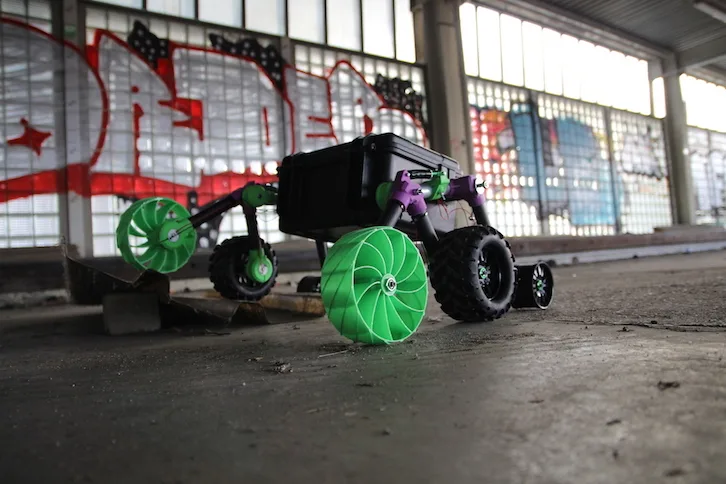
Getting aid into hard-to-reach places is slow, expensive and often dangerous. Ground Hawq was our 2017 attempt to chip away at that problem with a low-cost, autonomous ground vehicle built almost entirely from 3D-printed parts.
The idea was deliberately simple: a modular platform you could load with whatever a particular mission needed: a medical kit on one trip, a thermal imaging camera on the next, a sensor payload on a third. It could find its own way through the terrain without a driver alongside.
Recognition
Ground Hawq won The Hague Innovators 2017 award, organised by ImpactCity, the Hague’s innovation programme. The award recognised the project’s approach to using affordable, accessible manufacturing (3D printing) to take aim at a problem traditionally solved with much heavier and more expensive hardware.
What it became
Ground Hawq sat at the start of a longer line of work for us: autonomous platforms, modular payloads, building tools that field teams can actually own and modify. The lessons fed forward into later projects, from drones to camera networks. The robot itself was a prototype; the principle that hardware for humanitarian and conservation work has to be cheap, repairable and re-purposable is one we still build by.